Steak Doneness Temperature Chart: Pull Temps for Every Doneness
The short answer. Medium rare steak is 130°F to 135°F once it has rested. To land there, pull it off the heat at 123°F to 128°F and rest it 5 to 10 minutes. Carryover cooking does the last few degrees for you.
Every steak keeps cooking after it leaves the grill. That is the whole reason people overshoot: they cook to the number they want to eat instead of the number they want to pull at, and by the time it hits the plate it has gone past. Here is the full chart, both numbers, and how much carryover to expect on the steak you actually bought.
Steak doneness temperature chart
| Doneness | Pull at | Final temp |
|---|---|---|
| Rare | 115 to 118°F | 120 to 125°F |
| Medium rare | 123 to 128°F | 130 to 135°F |
| Medium | 133 to 138°F | 140 to 145°F |
| Medium well | 143 to 148°F | 150 to 155°F |
| Well done | 153°F and up | 160°F and up |
What each one looks like when you cut it:
- Rare. Cool red center, very soft to the touch, fat barely rendered.
- Medium rare. Warm red center edge to edge. The steakhouse standard, and where a ribeye or a strip tastes best.
- Medium. Warm pink center, noticeably firmer bite, more rendered fat.
- Medium well. A thin line of pink, drier, and lean cuts start to get chewy here.
- Well done. No pink. A well-marbled ribeye survives it better than a filet or a sirloin does.
These are cooking preferences, not safety guidance. The USDA recommends a minimum internal temperature of 145°F plus a three minute rest for whole cuts of beef. Here is the full USDA Safe Minimum Internal Temperature Chart.
Why there are two numbers
When you pull a steak off the heat, the outside is far hotter than the center. That heat keeps moving inward until the whole steak evens out, and the center climbs for several minutes after the steak is off the grill. That is carryover cooking, and on a thick steak it is worth 5°F to 10°F.
So the number you cook to is not the number you eat. If you pull a steak at 135°F because you want medium rare, it will finish around 142°F and arrive at the table medium. Pull at 125°F and it lands where you wanted.
How much carryover to expect
| Steak thickness | Carryover | Rest |
|---|---|---|
| Under 1 inch | 2 to 3°F | 5 minutes |
| 1 to 1.5 inches | 5°F | 5 to 8 minutes |
| 1.5 to 2 inches | 7 to 10°F | 10 minutes |
| Over 2 inches, or reverse seared | 3 to 5°F | 10 minutes |
The last row surprises people. A reverse seared steak carries over less than a hot-and-fast one of the same thickness, because it was cooked gently and the inside is already close to even. There is no big heat gradient left to move. Hot and fast builds a steep gradient, and that gradient is what drives carryover.
Where to put the thermometer
The reading is only as good as the placement, and this is where most home cooks go wrong.
- Probe from the side, not the top. On a steak an inch or so thick, going in from the top means the tip passes through the center in a fraction of an inch. From the side you can slide it along the length and actually find the middle.
- Aim for the thickest part. Steaks are not uniform. The thick end is what decides when the steak is done.
- Avoid bone and large fat seams. Bone reads hotter and fat reads cooler. On a bone-in ribeye or a tomahawk, stay at least half an inch off the bone.
- Push through and pull back. Slide the probe past the center, then draw it back slowly and watch for the lowest number. That low point is the true center.
One thing worth knowing: A cheap dial thermometer can take 20 seconds to settle and be off by 5°F, which is the entire difference between medium rare and medium. If you are going to trust a number, it has to be a number you can trust.
Resting, and what it actually does
Rest a steak 5 to 10 minutes before you cut it. Two things happen in that window.
The first is carryover, above. The second is that the muscle fibers relax and reabsorb some of the liquid that high heat pushed toward the center. Cut too early and that liquid runs onto the board instead of staying in the meat.
Rest it uncovered. Foil, even loosely tented, traps steam against the crust you just built and softens it. A rack or a board in a warm kitchen holds plenty of heat for ten minutes.
No thermometer? Use the pressure test
Less accurate, but better than cutting into it. Open your hand, relaxed, and press the fleshy pad at the base of your thumb with a finger. Then touch your thumb to each fingertip in turn and press that same pad again. It firms up as you go, and it maps closely to how a steak feels.
| Touch thumb to | Feels like |
|---|---|
| Nothing, hand relaxed | Rare |
| Index finger | Medium rare |
| Middle finger | Medium |
| Ring finger | Medium well |
| Little finger | Well done |
It works better on thick, evenly shaped cuts than on thin or irregular ones, and it takes practice to read reliably. Treat it as a backup rather than a method.
Best doneness by cut
Every cut has a temperature where it is at its best, and it is not the same number for all of them.
| Cut | Best at | Why |
|---|---|---|
| Ribeye | Medium rare to medium | Enough marbling that it needs a little more heat to render |
| New York strip | Medium rare | Leaner than a ribeye and tightens up past that |
| Filet mignon | Rare to medium rare | Very lean. Past medium it turns dry and loses the texture you paid for |
| Picanha | Medium rare | The fat cap wants rendering, the meat under it does not want more |
| Sirloin | Medium rare | Lean and unforgiving. This one punishes overshooting |
| Skirt and flank | Medium rare | Thin and fast. See the skirt steak guide |
| Tri-tip | Medium rare | Thickness varies a lot end to end, so probe the thick end. See our reverse seared tri-tip |
| Prime rib | Medium rare | Large roast, more carryover. See the prime rib cheat sheet |
The leaner the cut, the less room you have. A ribeye at 145°F is still pleasant. A filet at 145°F is a waste of a filet.
Ground beef is different
Everything above is for whole muscle cuts. On a whole steak, bacteria live on the surface, and searing the outside handles them, which is why a rare steak is a normal thing to serve.
Grinding mixes the surface all the way through. That is why burgers and any ground beef should reach 160°F, and why "medium rare" is not a meaningful target for a supermarket burger the way it is for a steak.
The two tools that make this automatic.
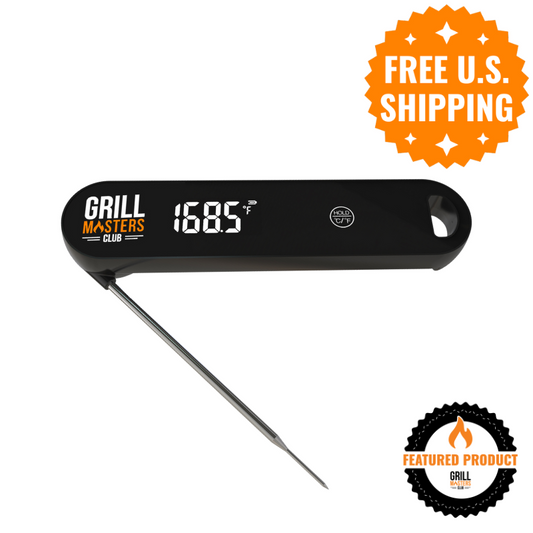
A digital instant read thermometer gives you the number in a couple of seconds, and our Meat Smoking Mastery Time & Temperature Guide Magnet is this chart plus every other protein, stuck to the side of your grill where you need it. Beef, pork, chicken, turkey and lamb, with target temps and approximate times.
Shop the instant read thermometerCooking thick steaks? The Upper Crust Steak Box pairs the thermometer with a dry brining rack, wagyu tallow and steak seasonings. Want new rubs and sauces every delivery? See the Grill Masters Club subscription.
Questions we get asked
What temp is medium rare steak?
130°F to 135°F after resting. Pull the steak off the heat at 123°F to 128°F and carryover cooking will bring it the rest of the way during a 5 to 10 minute rest.
What is the internal temperature for a medium steak?
140°F to 145°F final. Pull at 133°F to 138°F.
Should I cook to the final temperature or pull early?
Always pull early. A steak keeps cooking off the heat, by 2 to 3°F on a thin cut and up to 10°F on a thick one. Cooking to the number you want to eat is the most common way people overshoot.
How long should a steak rest?
Five to ten minutes, uncovered. Thin steaks need five, thick ones closer to ten. Covering it with foil traps steam and softens the crust.
Where do you put the thermometer in a steak?
Into the side, along the length, aiming for the thickest part of the center. Stay off the bone and out of large fat seams. Push past the middle and draw back slowly, watching for the lowest reading.
Is 145°F medium or medium well?
145°F is the top of medium. It is also the USDA minimum recommended temperature for whole cuts of beef, which is why it appears on so many charts as a safety number rather than a doneness preference.
Does a reverse seared steak carry over as much?
No, less. Cooking gently to temperature leaves the inside close to even, so there is no steep heat gradient left to push the center higher. Expect 3 to 5°F instead of the 7 to 10°F a thick hot-and-fast steak will climb.
What temperature should burgers be?
160°F. Ground beef is not the same as a whole steak, because grinding distributes surface bacteria throughout the meat rather than leaving them on an exterior the sear will handle.
Can I tell doneness without a thermometer?
Roughly, with the pressure test described above. It is a useful backup and it is much better than cutting the steak open, but it takes practice and it is least reliable on thin or irregular cuts.
Hitting the number is one part of it. For cut selection, two-zone fires, searing and slicing, see our complete guide to grilling steak, and for thick cuts specifically, how to reverse sear a steak.
Join 100,000+ Grill Masters
Get weekly recipes, pro tips, and exclusive deals sent straight to your inbox. Plus your free Pit Card download and 10% off your first order.