
How to Grill a Turkey for Thanksgiving: The Complete 2026 Guide
We built the ultimate brine kit
Turkey Takeover Box
Brine, 2 seasonings, brine bag, injector, and a printed booklet with 6 Thanksgiving recipes & 2 bonus tips.

You've got the bird. Prep it with the brine kit, and let's make this a most memorable Thanksgiving.
$64.99 $49.99
Turkey Takeover ships free in the U.S., and code USA takes an extra 10% off. Order by Nov 19 to have it in time for Thanksgiving.
Last updated October 6, 2026. Rewritten for the 2026 season with current USDA food-safety guidance, revised brining times and a corrected doneness temperature.
Cooking the turkey outside is the best decision you can make about Thanksgiving. It frees the oven for everything else, it gives the bird a flavor no oven produces, and it turns the most stressful cook of the year into the one you look forward to.
Quick answer: buy a 12 to 16 pound bird, thaw it in the refrigerator, brine it 12 to 24 hours if it has not been enhanced, dry the skin overnight, inject and season the morning of, and cook over indirect heat at 325F until the breast, thigh and wing all read 165F. Rest 20 to 30 minutes, then carve.
Everything below expands on that, from the Saturday grocery run to Thursday's leftovers. It works on a gas grill, a charcoal kettle, a pellet grill, a kamado or an offset. If you want the brine, the bag, the injector and the seasonings already matched to this method, that is exactly what the Turkey Takeover turkey brine, injection and seasoning kit was built to do.

What This Guide Covers
- Choosing your turkey
- Thawing, and how long it really takes
- Brining
- Injecting
- Seasoning
- Drying the skin
- Setting up your grill or smoker
- Choosing wood
- Cooking: temperature and time
- Doneness
- Resting and carving
- Troubleshooting
- Leftovers
- The full week timeline
1. Choosing Your Turkey
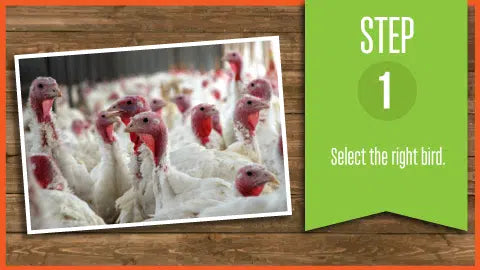
Buy 12 to 16 pounds. That range feeds a Thanksgiving table, fits on a 22 inch kettle or a mid-size pellet grill without a fight, and cooks evenly. Most grills will not take a 25 pound bird at all. Plan on 1 to 1.5 pounds of raw turkey per person, toward the top of that if you want leftovers, which you do.
Feeding a big group? Cook two smaller birds rather than one enormous one. More wings, more legs, more crispy skin, and a far more predictable cook.
Fresh, frozen, enhanced or heritage
The label matters more than the brand. Look for enhanced, self-basting, pre-brined, injected or contains up to X% solution. Any of those means salt and liquid were added at the plant, and it changes your whole seasoning plan.
- Frozen supermarket birds commonly carry an 8 to 12 percent solution. Inexpensive and forgiving, but already salted.
- Fresh and air-chilled birds are more often untreated, which makes them the best candidates for brining.
- Kosher turkeys are salted during processing. Treat them as already brined.
- Heritage breeds are leaner and more strongly flavored, with less breast meat. They cook faster than the chart suggests, so watch the probe.
2. Thawing, and How Long It Really Takes

This is the step people underestimate every single year. A partially frozen turkey cannot be cooked safely or predictably, and there is no fixing it on Thursday morning.
| Turkey Weight | In the Refrigerator | In Cold Water |
|---|---|---|
| 8 to 12 lbs | 2 to 3 days | 4 to 6 hours |
| 12 to 16 lbs | 3 to 4 days | 6 to 8 hours |
| 16 to 20 lbs | 4 to 5 days | 8 to 10 hours |
| 20 to 24 lbs | 5 to 6 days | 10 to 12 hours |
Refrigerator thawing runs about 24 hours per 4 to 5 pounds and is the method we recommend, because the bird stays at a safe temperature the whole time. Keep it in a pan on the bottom shelf so nothing drips onto anything else.
Cold water thawing runs about 30 minutes per pound. Keep the turkey in its sealed wrapper, fully submerged, and change the water every 30 minutes. Cook it the same day.
Never thaw a turkey on the counter.
3. Brining

If the bird is untreated, brine it. Salt seasons the meat all the way through rather than sitting on the surface, and it improves how a lean bird holds moisture during cooking. Dry turkey is the most common Thanksgiving complaint, and this is the first place to fix it.
12 to 24 hours, refrigerated at 40F or below. Not longer than two days, or the texture starts heading toward ham. Longer is not stronger, and stronger is not better.
A wet brine gives you a designed blend of salt, sugar and aromatics carried through the whole turkey. The Super Soaker Bird Brine in the Turkey Takeover Box is built on salt, brown sugar, mustard seed, black pepper, coriander, thyme, juniper berry and bay leaf, and one bag covers a 12 to 16 pound bird in the included 3 gallon brine bag. A dry brine skips the water entirely and dries the skin as a bonus.
No refrigerator space? A clean, food-safe cooler works, packed with enough ice to hold 40F or below for the whole window. Check it before bed and again in the morning.
Pat dry, do not rinse.
This is a change from how many of us learned to do it. The USDA advises against washing raw poultry, because rinsing splashes bacteria around your sink and counters. Lift the bird out, let it drain, and pat it dry with paper towels. You lose nothing and you skip the mess.
Full detail, including what to do with an enhanced bird: should you brine a turkey before smoking.
4. Injecting
Injection does something brining cannot: it carries fat. Melted butter, stock and drippings go straight into the thickest muscle, which is why an injected breast reads richer than a brined one at the same doneness.
Work in a grid, roughly every 1 to 1.5 inches, across both breasts, both thighs and the drumsticks. Insert the needle deep, start the plunger, and withdraw slowly as you dispense so the liquid spreads instead of pooling in one pocket. Refrigerate 30 to 60 minutes afterward to let it settle.
Keep the liquid warm rather than hot, and strain anything with ground seasoning in it so the needle does not clog.
5. Seasoning
Season generously. A 12 to 16 pound turkey takes 3 to 4 tablespoons of rub for full coverage, and some of it is going to end up on the grate. Use a blend built for poultry rather than a heavy beef rub.
Get seasoning under the breast skin as well as over it. Loosen the skin carefully with your fingers and work rub, or softened herb butter, directly against the meat.
On the outside, use a thin coat of olive or avocado oil as the binder rather than butter, for reasons in the next section.
Watch your total salt. Count what the processor added, what the brine added, what is in the injection, and what is in the rub. Four salty layers on an already-enhanced bird is how a turkey ends up uneaten.
6. Drying the Skin

Crispy skin is decided the day before, not in the last fifteen minutes.
After brining and patting dry, leave the turkey uncovered in the refrigerator overnight. Cold circulating air pulls moisture out of the skin and leaves it taut and slightly translucent, which is exactly the surface you want going onto the grill.
Then oil the outside rather than buttering it. Butter is roughly 15 percent water, so slathering it on puts back the moisture you spent all night removing. Butter belongs under the skin. Full method: how to get crispy skin on smoked turkey.
7. Setting Up Your Grill or Smoker

Whatever you are cooking on, you need the same three things: a stable 325F, indirect heat, and room for air to move around the bird. No burners and no coals directly under the turkey, ever. Put a drip pan underneath, both to catch the fat and to keep flare-ups from scorching the skin.
Gas grill
Light the burners on one side only and put the turkey on the unlit side over a drip pan. A smoker box or a foil pouch of wood chips over the lit burners gets you the wood character. Let it preheat at least 15 minutes before the bird goes on.
Charcoal kettle
Bank the coals to one side, or use a charcoal basket on each side with a drip pan in the middle. Turkey goes over the drip pan. Top vent wide open, bottom vent adjusted to hold 325F. Plan on adding coals once during the cook.
Pellet grill
The easiest option. Set it to 325F and let it stabilize. Pellet grills produce lighter smoke than a stick burner, so run a smoke tube for the first hour if you want more character.
Kamado
Use the heat deflector. Kamados hold temperature well but respond slowly, so bring it up to 325F gradually. Overshooting a kamado is much harder to correct than undershooting it.
Offset smoker
Run a small, hot, clean-burning fire rather than a smoldering one. Turkey takes smoke readily, and a lazy fire on poultry gives you a bitter, sooty exterior fast.
One rule for all of them: do not crowd the cooker. A turkey wedged against the walls or sharing the grate with three pans of sides ends up steaming on the crowded side.
8. Choosing Wood
Turkey takes smoke easily, so restraint beats volume. Our default pairing is apple and cherry: apple is mild and forgiving, cherry gives you color.
Pecan and maple both work. Go easy on hickory, and skip mesquite entirely on poultry. For the full breakdown, see our complete guide to the best wood for smoking.
Do not soak your wood chips. This is old advice that has not held up. Wet wood produces steam and dirty white smoke before it ever produces clean smoke, and dirty smoke is exactly what makes turkey taste bitter. Use dry chips or chunks and use fewer of them.
9. Cooking: Temperature and Time
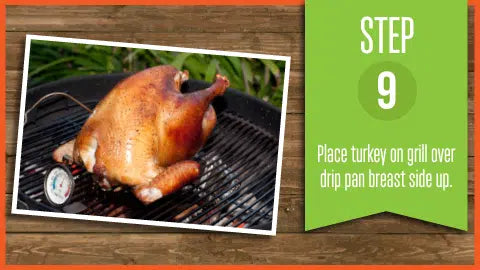
Cook at 325F, breast side up.
Turkey is not brisket. There is no connective tissue that needs ten hours to break down, and poultry skin needs real heat to render its fat and brown. At 325F you still get several hours of smoke exposure on a mid-size bird, and you shorten the window in which lean breast meat can dry out.
At that temperature, plan on roughly 13 minutes per pound for a whole bird:
| Weight | Whole at 325F | Spatchcocked at 325F |
|---|---|---|
| 10 to 12 lbs | 2.5 to 3 hours | 1.75 to 2.25 hours |
| 12 to 14 lbs | 3 to 3.5 hours | 2 to 2.5 hours |
| 14 to 16 lbs | 3.5 to 4 hours | 2.25 to 2.75 hours |
| 16 to 18 lbs | 4 to 4.5 hours | 2.5 to 3 hours |
The full chart, including 8 to 10 and 18 to 20 pound birds and what pushes a cook past the estimate, is in how long to smoke a turkey.
Whole or spatchcocked?
Spatchcocking, which means removing the backbone and flattening the bird, cuts 30 to 45 minutes off a mid-size turkey, cooks more evenly, and exposes more skin to heat. The tradeoff is the classic presentation. Here is how to spatchcock a turkey.
Cook the stuffing separately
Packing the cavity adds a temperature variable, slows the cook, and means the stuffing also has to reach 165F, which usually overcooks the breast getting there. Loose aromatics inside the bird are fine: onion, apple, lemon, garlic, rosemary, sage, thyme.
Keep the lid closed
Every peek dumps heat. So does spritzing, which also wets the skin you spent all night drying. Turkey does not need it. Close the lid, watch the probe, and let the cooker work.
10. Doneness
165F, measured in three places: the thickest part of the breast, the innermost thigh, and the innermost wing. Avoid bone, which reads hotter than the meat around it.
Put a leave-in probe in the breast when the bird goes on, then verify the other two spots with an instant-read as you approach the window. Do not trust the pop-up timer that came with the turkey. Those are calibrated well past done, and they are a large part of why so many Thanksgiving turkeys are dry.
Start checking about 45 minutes before the low end of your estimate. A turkey that finishes early rests happily. A turkey that finishes late has an audience.
11. Resting and Carving

Rest the bird 20 to 30 minutes before carving, tented loosely with foil. Tight foil traps steam and softens the skin you worked for. A whole turkey holds acceptably for 30 to 45 minutes, which is your buffer for finishing the sides.
Carving, in order:
- Remove both legs at the joint, then separate thigh from drumstick.
- Remove each whole breast by cutting along the breastbone and down along the ribs, so the breast comes off in one piece.
- Slice each breast crosswise against the grain, which keeps the slices from shredding.
- Take the wings off last.
- Arrange skin side up on a warmed platter.
Do not carve on the grill or on a flat board with no channel. You will lose the juices to the counter.
12. Troubleshooting
| Problem | Cause | Fix |
|---|---|---|
| Dry breast meat | Overcooked, almost always | Pull at 165F, not 175F. Spatchcock next time so breast and thighs finish together. |
| Rubbery skin | Wet skin, cooker too cool | Bump to 375F for the last 10 to 15 minutes. Next time, dry uncovered overnight. |
| Bitter, sooty flavor | Dirty smoke, too much wood, or soaked chips | Nothing to do mid-cook. Next time, less wood, cleaner fire, dry chips. |
| Too salty | Brined an enhanced bird, or stacked salty layers | Serve with unsalted gravy and plain sides. Next time, read the label first. |
| Done 90 minutes early | Small or spatchcocked bird, or a hot spot | Tent loosely and hold. It will be fine for 45 minutes, longer in a warm cooler. |
| Temperature stalled | Cooker dropped, or wind | Check the cooker's own thermometer before touching the bird. Move it out of the wind. |
| Skin dark, meat undercooked | Too much direct heat | Tent the breast with foil and finish. Verify your setup is truly indirect. |
13. Leftovers
Get the meat off the carcass and into the refrigerator within two hours. Store dark and white meat separately, and keep some skin on the pieces you plan to reheat.
Reheat gently with a splash of stock, covered, rather than blasting it in the microwave. Smoked turkey reheats better than roasted, and it makes a considerably better sandwich.
Keep the carcass. Smoked turkey stock is one of the real payoffs of cooking the bird outside, and it will improve every soup you make for the next two months.
14. The Full Week Timeline
For a 14 pound whole turkey and a 4:00 PM Thursday dinner:
- Saturday: buy the bird.
- Sunday: frozen turkey into the refrigerator to thaw.
- Tuesday evening: into the brine, 12 to 24 hours at 40F or below.
- Wednesday evening: out of the brine, drained, patted dry, uncovered in the refrigerator overnight.
- 11:15 AM Thursday: inject, oil, season. Grill comes up to 325F.
- 12:00 PM: turkey on.
- 2:45 PM: start checking temperature.
- 3:15 to 3:30 PM: 165F in breast, thigh and wing. Turkey off.
- 3:30 to 4:00 PM: rest, then carve.
Build in a 45 minute cushion. It is the difference between a calm afternoon and a tense one.
Keep this open on Thursday. Thaw times, brine times, smoking times by weight, the 165F check and this timeline, condensed to one page: the Smoked Turkey Cheat Sheet.
Watch It Done
Hat tip to Sammy Bromberg of Bearded BBQ Boys, whose grilled turkey reel ran in an earlier version of this guide.
Recipes That Use This Method
- The Perfect Brined Thanksgiving Turkey, the whole bird done start to finish.
- Beer Injected Spatchcocked Turkey, faster and crispier.
- Brined and Butter Injected Smoked Turkey Breast, for a smaller table.
Frequently Asked Questions
How do you grill a turkey for Thanksgiving?
Thaw the bird completely, brine it 12 to 24 hours if it has not been enhanced, dry the skin uncovered in the refrigerator overnight, inject and season the morning of, and cook over indirect heat at 325F until the breast, thigh and wing all read 165F. Rest 20 to 30 minutes before carving.
What size turkey should I buy?
12 to 16 pounds for most backyard cooks, at 1 to 1.5 pounds of raw turkey per person. Most grills will not fit a 25 pound bird. For a large group, cook two smaller birds rather than one very large one.
How long does a turkey take to thaw?
About 24 hours per 4 to 5 pounds in the refrigerator, so 3 to 4 days for a 12 to 16 pound bird. Cold water thawing takes about 30 minutes per pound with the water changed every 30 minutes, and the turkey must be cooked the same day.
Can you cook a turkey on a gas grill?
Yes. Light the burners on one side only, put the turkey on the unlit side over a drip pan, and hold 325F. Add a smoker box or a foil pouch of wood chips over the lit burners for smoke.
Should you soak wood chips before grilling a turkey?
No. Wet wood produces steam and dirty white smoke before it produces clean smoke, and dirty smoke is what makes turkey taste bitter. Use dry chips or chunks, and use fewer of them than you think you need.
Do you cook a turkey breast side up or down?
Breast side up, so the skin on the side everyone sees browns properly. If uneven cooking is the concern, spatchcock the bird rather than flipping it.
Should you rinse a turkey before cooking it?
No. USDA guidance advises against washing raw poultry, because rinsing spreads bacteria around the sink and counters. Remove the giblets and neck, drain the bird, and pat it dry with paper towels.
How long should a turkey rest before carving?
20 to 30 minutes, tented loosely with foil. A whole bird holds acceptably for 30 to 45 minutes.
Bring It All Together
Cook outside. Read the label. Brine an untreated bird, inject for depth, season generously, dry the skin the night before, hold 325F over indirect heat, and pull at 165F. That is the whole method, and it works on anything in the backyard.
Brine it. Inject it. Season it. Grill it.
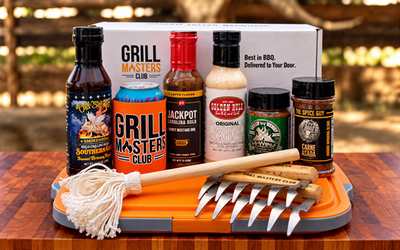
The Turkey Takeover Box from Grill Masters Club puts this whole method in one box: the Super Soaker Bird Brine, a 3 gallon brine bag, a high pressure marinade injector, Perfect Turkey Seasoning, Roasted Garlic Blend, and an 8 page printed booklet with six Thanksgiving recipes. Ships free in the US.
Planning the holiday ham too? Our Double Smoked & Glazed Ham Kit has the rubs, glazes and recipes for a December ham, and our candied bacon guide covers the appetizer.
Thanksgiving Turkey School
Discover. Refine. Master.
Join 100,000+ Grill Masters
Get weekly recipes, pro tips, and exclusive deals sent straight to your inbox. Plus your free Pit Card download and 10% off your first order.